
These formulas aren’t just numbers—they’re decision-making tools. Understanding what drives each one helps you actually improve your finances, not just calculate them.
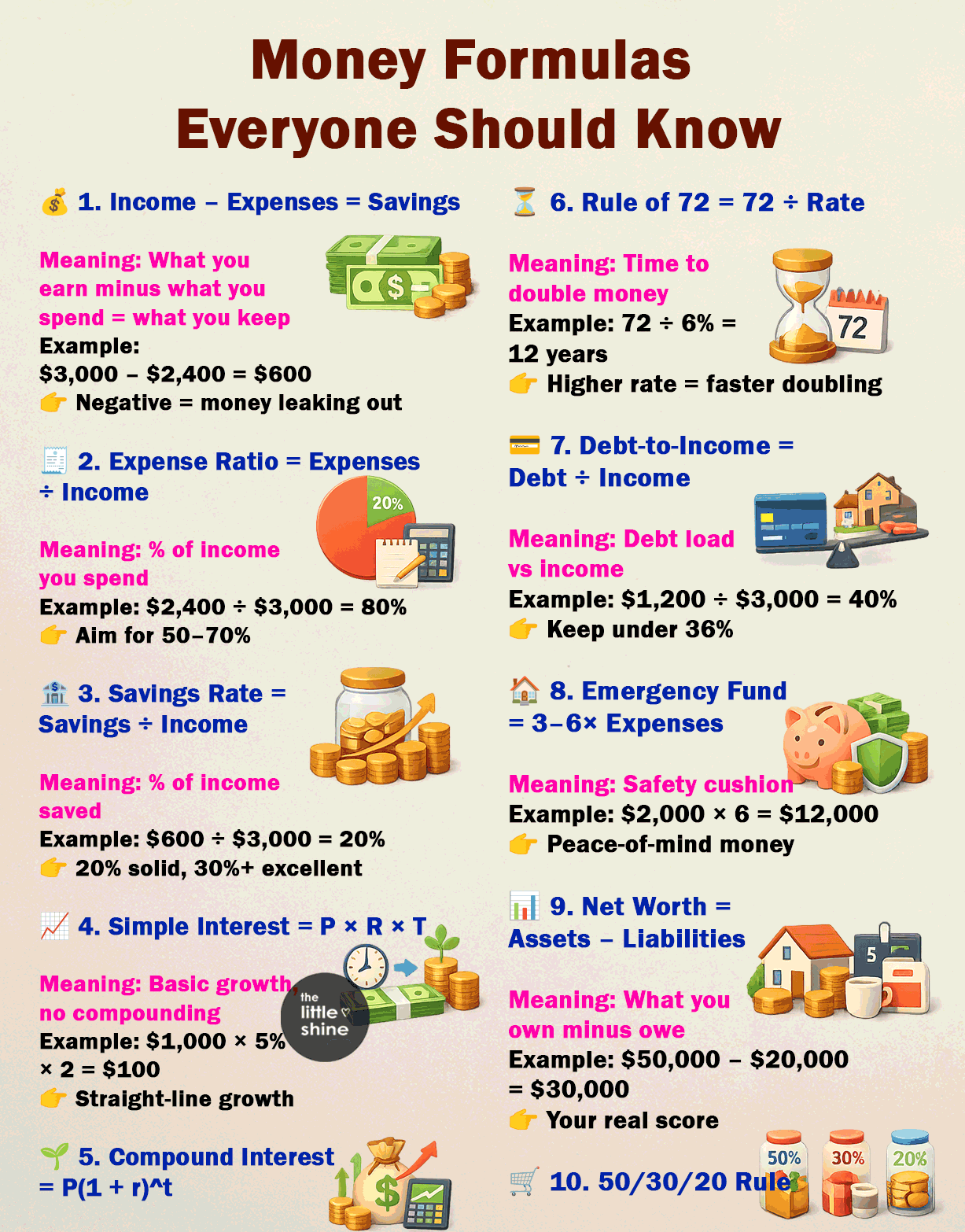
1. Income – Expenses = Savings
What it means:
This is your financial baseline. It shows whether your lifestyle is sustainable.
Example:
$3,000 – $2,400 = $600 saved
Extra insight:
- If savings = $0, you’re financially stagnant.
- If negative, you’re relying on debt or dipping into reserves.
- Improving this isn’t only about earning more—it’s often about controlling fixed expenses (rent, EMIs, subscriptions).
2. Expense Ratio = Expenses ÷ Income
What it means:
Shows how efficiently you use your income.
Example:
$2,400 ÷ $3,000 = 80%
Extra insight:
- High ratios reduce flexibility and increase stress.
- Fixed costs (housing, loans) usually drive this number up.
- Aim to lower “non-essential leakage” like impulse spending, subscriptions, and frequent dining out.
3. Savings Rate = Savings ÷ Income
What it means:
Your most important wealth-building metric.
Example:
$600 ÷ $3,000 = 20%
Extra insight:
- This directly determines how fast you can build wealth.
- Increasing your savings rate by even 5–10% has a massive long-term impact.
- Automating savings (auto-transfer to investments) makes consistency easier.
4. Simple Interest = P × R × T
What it means:
Interest earned only on the principal amount.
Example:
$1,000 × 5% × 2 = $100
Extra insight:
- Common in short-term loans or basic financial products.
- It does not benefit from time the way compounding does.
- Good for understanding basic borrowing costs, but not ideal for long-term investing.
5. Compound Interest = P(1 + r)^t
What it means:
Growth on both principal and accumulated interest.
Example:
$1,000 at 5% for 2 years = $1,102.50
Extra insight:
- Time is the biggest factor here—not just rate.
- Starting early beats investing larger amounts later.
- Missing years of compounding can significantly reduce long-term wealth.
6. Rule of 72 = 72 ÷ Rate
What it means:
Quick mental math to estimate doubling time. In the Rule of 72, the “rate” means the annual interest rate (or return rate) expressed as a percentage.
Example:
72 ÷ 6% = 12 years
Extra insight:
- Useful for comparing investment options quickly.
- Also applies to inflation—money loses value over time at a similar rate.
- Small increases in return can dramatically reduce doubling time.
7. Debt-to-Income Ratio = Debt ÷ Income
What it means:
Indicates how much of your income is tied up in debt payments.
Example:
$1,200 ÷ $3,000 = 40%
Extra insight:
- Lenders use this to assess your risk.
- High DTI reduces your ability to save or invest.
- Focus on reducing high-interest debt first (like credit cards).
8. Emergency Fund = 3–6 × Monthly Expenses
What it means:
A buffer for unexpected situations.
Example:
$2,000 × 6 = $12,000
Extra insight:
- If income is unstable (freelancing/business), aim closer to 6 months or more.
- Keep this money liquid (savings account, not locked investments).
- This prevents you from going into debt during emergencies.
9. Net Worth = Assets – Liabilities
What it means:
Your overall financial health.
Example:
$50,000 – $20,000 = $30,000
Extra insight:
- Assets include cash, investments, property.
- Liabilities include loans, credit cards, mortgages.
- Track this every 6–12 months to measure real progress—not just income.
10. 50/30/20 Rule
What it means:
A structured way to allocate income.
Example (on $3,000):
- Needs: $1,500
- Wants: $900
- Savings: $600
Extra insight:
- This is a guideline, not a strict rule.
- In high-cost cities, “needs” may exceed 50%—adjust accordingly.
- If you want faster wealth growth, shift toward 50/20/30 or even 50/10/40 (higher savings).
Final Takeaway
These formulas work best when used together—not in isolation. Tracking them monthly gives you a clear picture of where your money is going and how to improve it.