You believe you’re in control.
Neurologically, you’re negotiating.
Your behavior is the output of interacting neural circuits and hormonal systems — some ancient, some highly evolved. Below is a practical breakdown of the key players shaping your mood, focus, cravings, stress response, sleep, habits, and relationships.
This isn’t motivation.
It’s neurobiology.
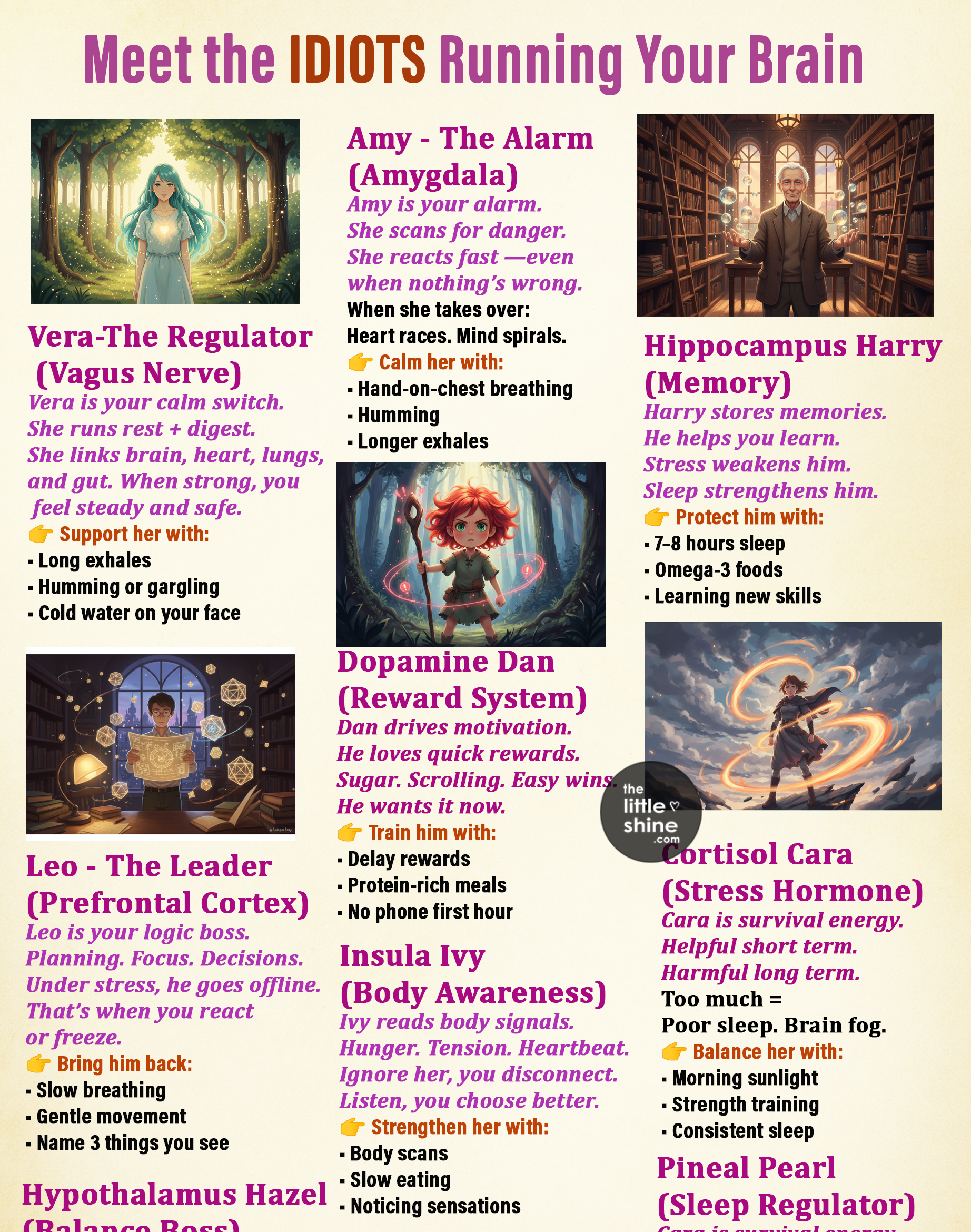
🧨 Amy — The Alarm (Amygdala)
Amy scans for danger.
Real threat? She’s brilliant.
Email tone misread as hostility? She still sounds the siren.
When she takes over:
- Heart races
- Thoughts spiral
- You react fast — often without thinking
Calm her with:
- Hand-on-chest breathing
- Humming
- Longer exhales
🌿 Vera — The Regulator (Vagus Nerve)
Vera is your calm switch.
She runs rest + digest.
She links brain, heart, lungs, and gut.
When she’s strong, you feel steady and safe.
Support her with:
- Long exhales
- Humming or gargling
- Cold water on your face
📚 Hippocampus Harry — Memory Builder
Harry stores memories and helps you learn.
Stress weakens him.
Sleep strengthens him.
Chronic stress literally shrinks his efficiency.
Protect him with:
- 7–8 hours sleep
- Omega-3 foods
- Learning new skills
🧠 Leo — The Leader (Prefrontal Cortex)
Leo is your logic boss.
Planning. Focus. Decisions.
Under stress? He goes offline.
That’s when you react, freeze, or say things you regret.
Bring him back with:
- Slow breathing
- Gentle movement
- Naming 3 things you see
⚡ Dopamine Dan — Reward System
Dan drives motivation.
He loves quick rewards.
Sugar. Scrolling. Easy wins. He wants it now.
Untrained, he chases stimulation.
Trained, he builds discipline.
Train him with:
- Delaying rewards
- Protein-rich meals
- No phone first hour of the day
🔥 Cortisol Cara — Stress Hormone
Cara is survival energy.
Helpful short term. Harmful long term.
Too much = poor sleep, brain fog, fat storage, irritability.
Balance her with:
- Morning sunlight
- Strength training
- Consistent sleep
💛 Insula Ivy — Body Awareness
Ivy reads body signals.
Hunger. Tension. Heartbeat.
Ignore her, you disconnect.
Listen to her, you choose better.
Strengthen her with:
- Body scans
- Slow eating
- Noticing sensations
😊 Serotonin Sam — Mood Stability
Sam keeps your mood steady.
Contentment. Confidence. Emotional balance.
Low levels? Irritability. Low drive. Overthinking.
Support him with:
- Morning sunlight
- Regular exercise
- Tryptophan-rich protein
- Consistent sleep
🤝 Oxytocin Olive — Bonding Hormone
Olive builds trust and connection.
She thrives on warmth and safety.
Isolation weakens her.
Connection grows her.
Boost her with:
- Hugs and physical affection
- Eye contact
- Meaningful conversations
- Acts of kindness
🔁 Basal Ganglia Ben — Habit Automation
Ben runs your habits.
Repeat something enough — he automates it.
Good routines? He locks them in.
Bad patterns? Same story.
Train him with:
- Consistent routines
- Small daily repetition
- Environment design
- Habit stacking
🚪 Thalamus Theo — Sensory Gatekeeper
Theo filters incoming information.
Sound. Light. Touch. Signals.
Overload him and you feel overwhelmed, distracted, irritable.
Protect him with:
- Reduced screen time
- Quiet breaks
- Nature exposure
- Limiting multitasking
⚖️ Hypothalamus Hazel — Homeostasis Manager
Hazel maintains internal balance.
Temperature. Hunger. Hormones. Circadian rhythm.
Under chronic stress, she shifts into survival mode.
Support her with:
- Regular meal timing
- Hydration
- Stable sleep schedule
- Stress reduction
🎯 Nucleus Accumbens Nick — Craving Center
Nick drives desire and anticipation.
He lights up for rewards.
Highly sensitive to:
- Sugar
- Ultra-processed food
- Novelty
- Social media
Stabilize him with:
- Delayed gratification
- Reducing hyper-palatable foods
- Goal-based rewards
- Dopamine detox periods
🔄 Anterior Cingulate Abby — Emotional Control & Focus Switching
Abby manages emotional regulation and cognitive flexibility.
She helps you shift attention and manage internal conflict.
Chronic stress fatigues her.
Strengthen her with:
- Mindfulness meditation
- Cognitive reframing
- Single-task focus
- Breath regulation
🌙 Pineal Pearl — Sleep Regulator
Pearl controls melatonin release.
She governs your sleep–wake rhythm.
Artificial light confuses her.
Darkness empowers her.
Protect her with:
- No screens 60 minutes before bed
- A dark sleep environment
- Consistent sleep timing
- Morning sunlight exposure
The Big Truth
None of them are actually idiots.
They’re survival systems running on ancient code —
designed for threat detection, energy conservation, bonding, reproduction, and pattern formation.
But modern life overstimulates them.
When you:
- Sleep well
- Regulate stress
- Move daily
- Eat strategically
- Seek real connection
You don’t silence the board. You lead it.