Money doesn’t require complicated math—it runs on a few simple formulas repeated consistently. Learn these, and your finances start making sense instead of feeling random.
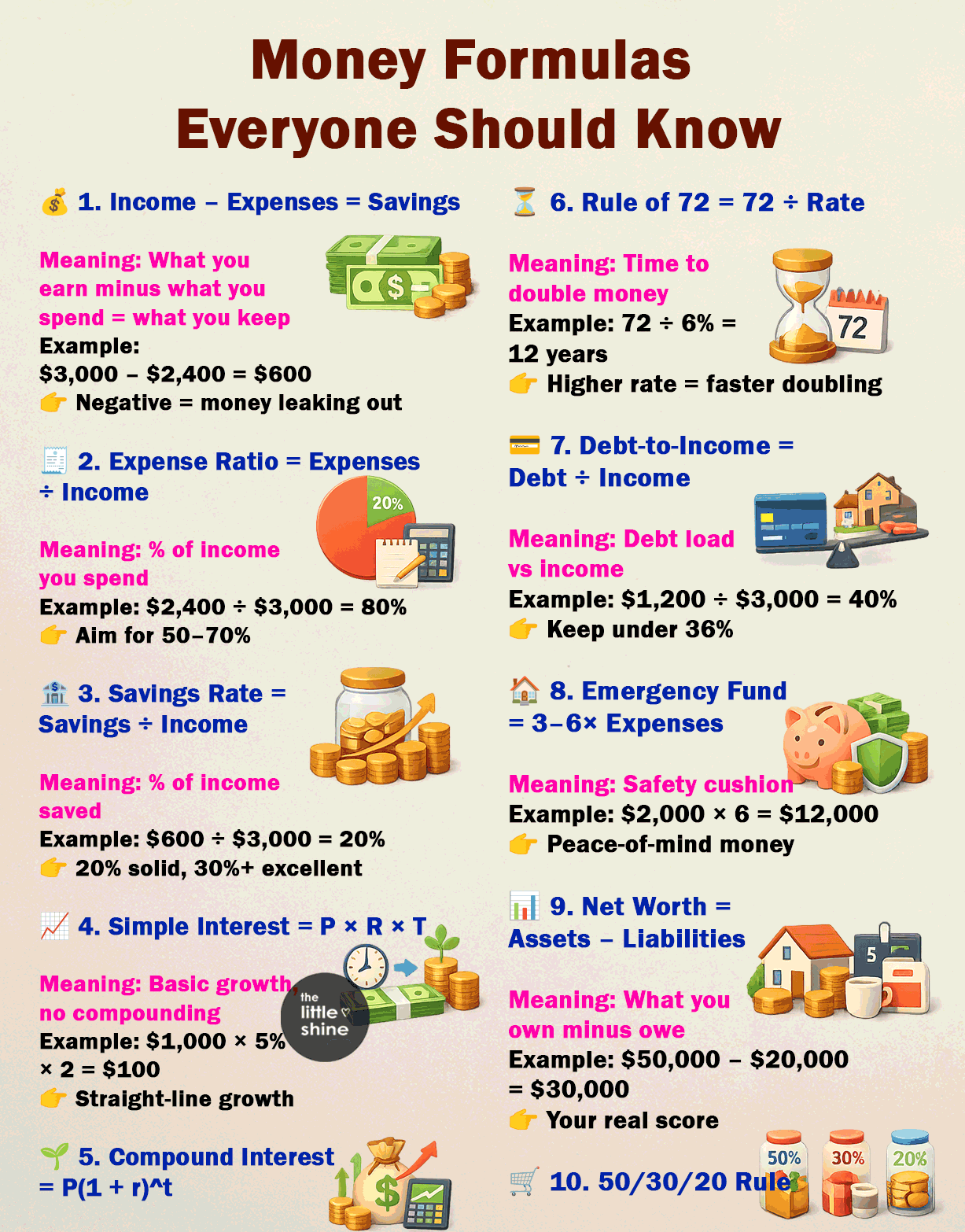
💵 1. Income – Expenses = Savings
This is the foundation of all personal finance.
Whatever you earn minus what you spend is what you actually keep.
If this number is negative, you’re not just spending—you’re slowly falling behind.
🧾 2. Expense Ratio = Expenses ÷ Income
This tells you how much of your income you’re using up.
A high ratio means your money disappears quickly.
A lower ratio means you have breathing room.
🏦 3. Savings Rate = Savings ÷ Income
This is one of the most powerful numbers in your financial life.
It shows how much of your income you’re keeping for the future.
The higher this number, the faster you build stability and freedom.
📈 4. Simple Interest = P × R × T
This is the most basic way money grows.
You earn interest only on the original amount—not on past interest.
It’s predictable, steady, and limited.
🌱 5. Compound Interest = P(1 + r)^t
This is where money starts to feel alive.
Your interest earns its own interest, creating a snowball effect over time.
The longer you stay invested, the faster it grows.
⏳ 6. Rule of 72 = 72 ÷ Interest Rate
A quick shortcut to estimate how long it takes to double your money.
Higher returns shrink time. Lower returns stretch it.
It’s a fast mental tool for understanding growth.
💳 7. Debt-to-Income Ratio = Debt ÷ Income
This shows how heavy your debt is compared to what you earn.
A high ratio can limit your financial options.
A lower ratio gives you flexibility and control.
🏠 8. Emergency Fund = 3–6× Monthly Expenses
Life is unpredictable. This formula prepares you for that.
It ensures you can handle job loss, emergencies, or sudden expenses without panic.
📊 9. Net Worth = Assets – Liabilities
This is your true financial position.
Not your salary, not your lifestyle—but what you actually own after subtracting what you owe.
🛒 10. 50/30/20 Rule
A simple way to manage your income:
- 50% for needs
- 30% for wants
- 20% for savings
It creates balance between living now and preparing for later.
🧠 Final Thought
Money isn’t about complexity—it’s about consistency.
These formulas are small on their own, but together they act like a system.
Follow them regularly, and your finances shift from chaos to control—quietly, steadily, and almost effortlessly.